


Description
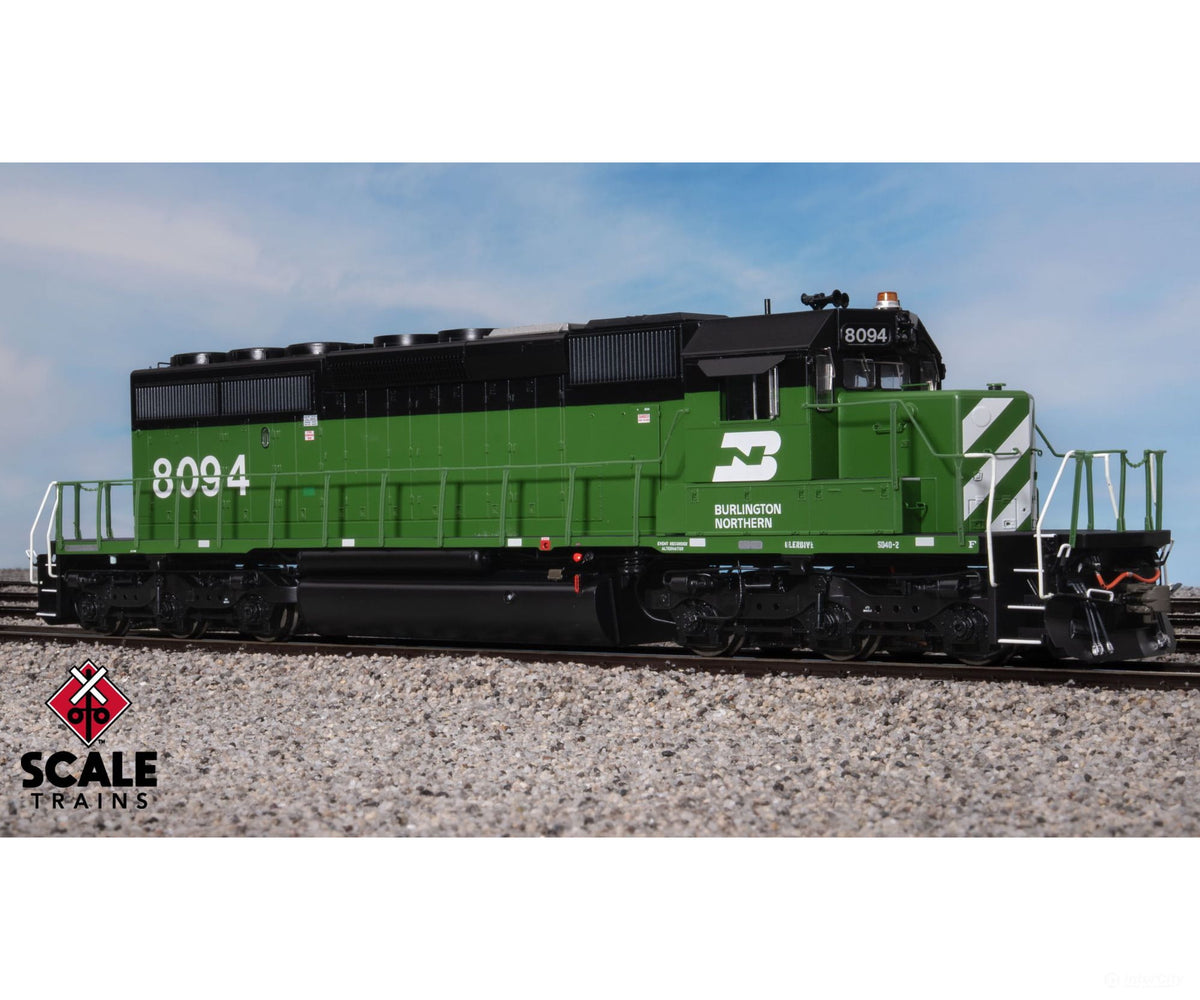
The Rivet Counter™ series SD40-2 is the definitive HO Scale model of EMD’s best-selling diesel locomotive. Our model combines smooth operating performance with unparalleled railroad, road number, and era specific details™. Even though the first SD40-2s were built 50 years ago, many continue in revenue freight service today.
Road Number Specific ScaleTrains
- New road numbers
- Era: mid 1980s to early 1990s
- Series 8090 to 8181; 5-7/1980
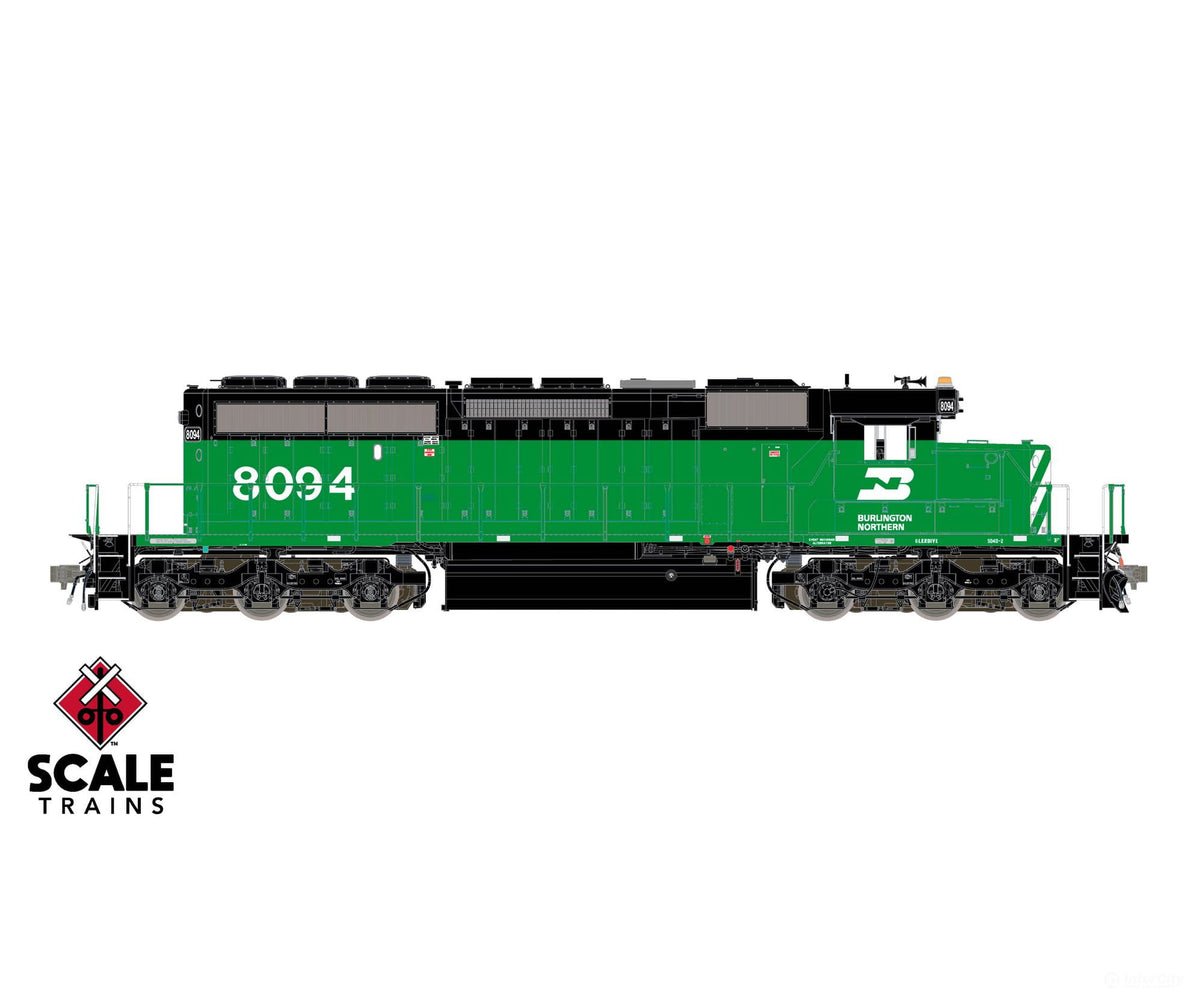
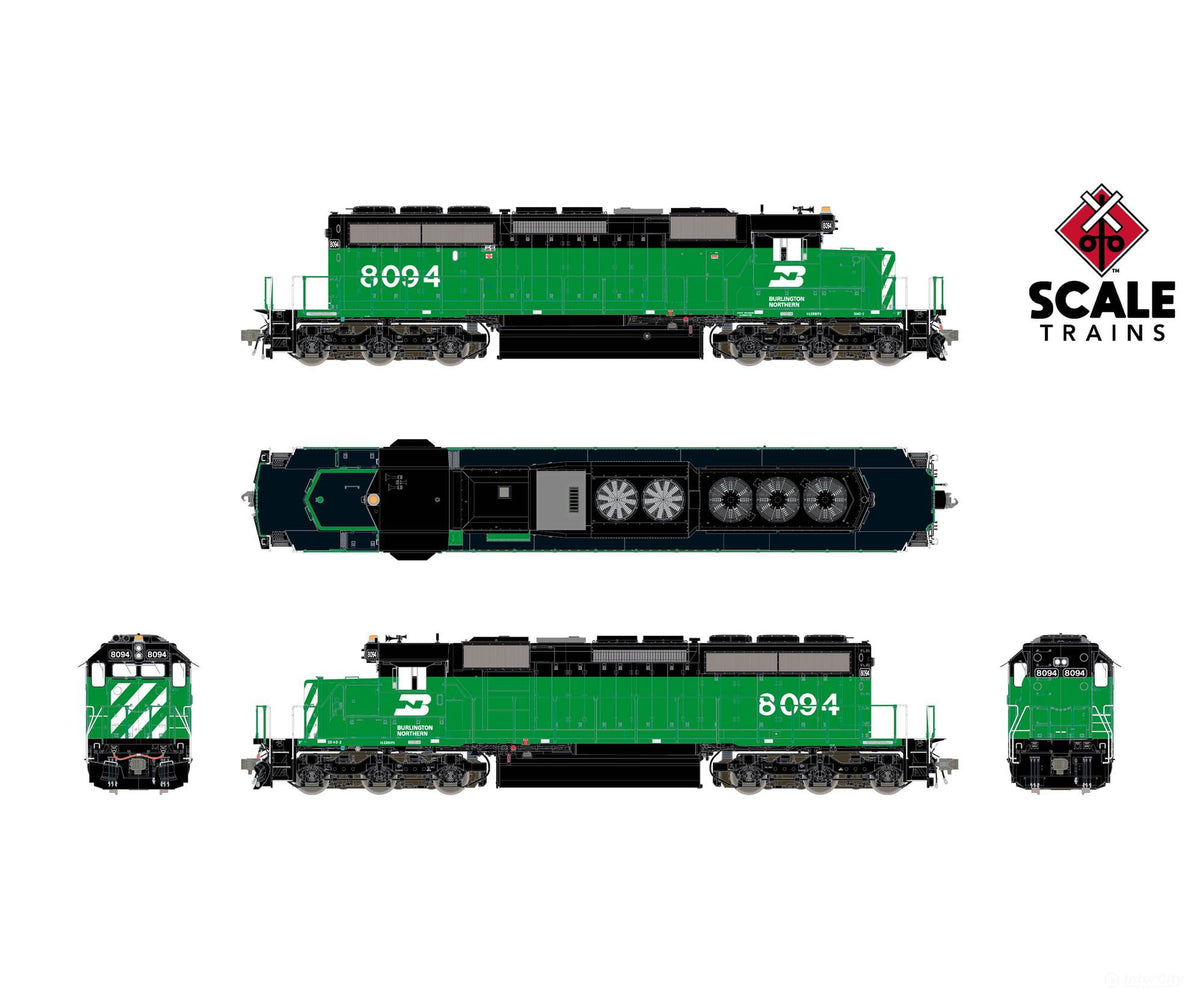
- Road number 8094
- Blanked front class lights with round plate, blanked rear class lights with gasket
- Tall clear wind wings with mirror at bottom mounted fore of cab side window on both sides of cab
- Spare knuckle holders on fuel tank near fuel filler
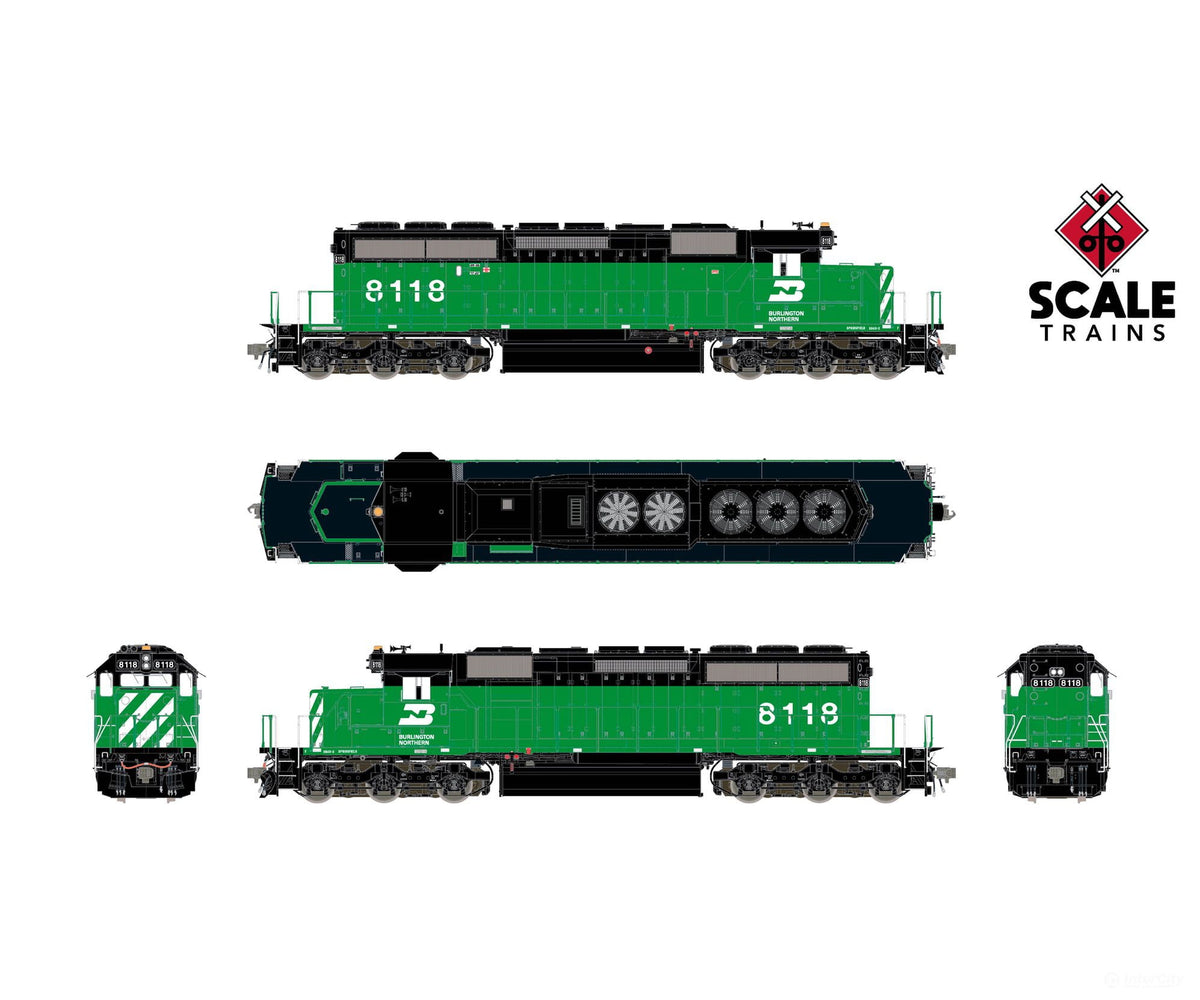
- Road number 8118
- Blanked front class lights with round plate, blanked rear class lights with gasket
- Small mirrors mounted fore of cab side windows on both sides of cab
- Spare knuckle holders on fuel tank near fuel filler
- Road number 8134
- Blanked front class lights with round plate, blanked rear class lights with gasket
- Tall clear wind wing with mirror at bottom mounted fore of cab side window on right side of cab, Small mirror mounted for of cab side window on left side of cab
- Fully-assembled
- Multiple road numbers
- No truck ground lights (prototype not equipped)
- LED-Illuminated round walkway lights mounted between front sanding valve doors; rectangular walkway lights mounted between rear sanding valve doors and round walkway light, aft of raised walkway duct*
- Directional LED-illuminated headlights
- LED-illuminated Prime PM-8911 Stratolite beacon*
- Printed number boards with separately controlled backlit LED-illumination*
- Front EMD-style low pilot plow with multiple unit (MU) hose doors and grab irons
- 3-hose multiple unit (MU) hose clusters with silver gladhands
- Semi-scale coupler buffer equipped with durable metal semi-scale Type E bottom-shelf knuckle couplers, painted a dingy gray/brown color to represent the color of couplers in service
- Front and rear straight uncoupling levers with loop handles and four inner mounting brackets
- Notched pilot faces with high angled lifting slots
- Pilot face mounted multiple unit (MU) receptacles
- Dummy multiple unit (MU) receptacles mounted to pilot face
- "Tall" stepwells with see-through steps
- Narrow “blunt” front anticlimber
- Handrail set with anticlimber front; inward facing rear end rail mounting brackets and chain
- Rear late “fixed” drop step
- Scale sectioned treadplate detail on walkways
- 88" low short hood with ratchet handbrake and straight handbrake chain guard and round vent on lower right side
- BN-style latched battery box doors with narrow louvers and lift-off hinges
- Late cab sub-base doors with lift-off hinges
- Standard EMD headlight in number board housing
- Dash-2 cab with welded side window panels
- Rear cab side vent on left side
- Detailed cab interior with separate floor, rear wall, seats, and standard AAR control stand
- Sliding cab side windows
- (tall clear wind wings removed here and broken down above)
- Standard EMD sunshades with long sunshade tracks
- Lost-wax brass cast Leslie RS-3K-R horn mounted on the cab
- Motorola ASP-16 “firecracker” antenna mounted on the cab and small can EOT antenna added on front left numberboard housing
- Accurate hood door and long hood detail
- Late electrical cabinet "zig-zag" seam, closer to the rear of the cab
- Late welded ECAFB
- Late inertial air intake grilles with top and bottom drip rail
- “Post-1980” exhaust silencer
- Accurately-profiled "post-1980" standard-range dynamic brake housing
- See-through dynamic brake intakes with resistor grid detail
- Corrugated radiator intake grilles
- See-through 48” single-speed radiator "Q-Fans” with fan blades visible inside
- Angled radiator fan grab iron
- Underbody frame rail with separate plumbing and traction motor cables
- Detailed HT-C trucks with Hyatt bearing caps, late center axle snubbers, sanding lines and brackets, and D-77 traction motor and air duct details
- Wheel faces painted a dingy gray/brown color to represent the color of wheelsets in service
- Dimensionally accurate truck centers
- Speed recorder mounted to third axle on right front
- Rearward-facing handbrake chain mount for HTC trucks
- Short jacking pads (late)
- Aft engineer’s side sidesill notch
- Tab-mount EFCO
- Frame-mounted steel bell
- Graham-White (Salem) brand 824-170 and 818-170 primary and secondary centrifugal air filters (accordion-style)
- 4,000-gallon fuel tank with dual fuel fillers, vertical gauge, round gauge in tank (right side only), and vertical breather pipe
- Factory-applied wire grab irons, wire lift rings, windshield wipers, trainline hoses with silver gladhands, sand hatch covers, and much more
- Motor with 5-pole skew wound armature
- Dual flywheels
- All-wheel drive
- All-wheel electrical pick-up
- Printing and lettering legible even under magnification
- Operates on Code 70, 83, and 100 rail
- Packaging safely stores the model
- Minimum radius: 18”
- Recommended radius: 22”
DCC & sound equipped locomotives also feature:
- ESU LokSound 5 DCC & Sound decoder with “Full Throttle” functions
- Two (2) cube-type speakers
- Turbocharged EMD 16 Cylinder 645E3 prime mover
- ESU designed “PowerPack” with two super capacitors***
- Operates on both DC and DCC layouts
DC/DCC & sound ready locomotives also feature:
- Operates on DC layouts
- DCC ready with 21-pin connector
* Lighting features operate when using an ESU decoder with appropriate programming while operating using DCC.
** In DC operation, both front ditch lights illuminate; rear ditch lights (if equipped) do not illuminate.
*** Class lights illuminate in white color only in DC operation. Access and change the colors with an appropriately programmed ESU decoder while operating using DCC.
**** “PowerPack” feature is only compatible with appropriately programmed ESU decoders operating on a DCC layout.
In January 1972, the Electro-Motive Division (EMD) of General Motors introduced the first production models of a locomotive design that would prove legendary: the SD40-2. As the flagship of the revolutionary “Dash-2” series, the SD40-2 was developed to improve upon its predecessor, the SD40, by incorporating state-of-the-art electrical and mechanical refinements that enhanced reliability, ease of maintenance, and operational efficiency.
The SD40-2 retained the same sixteen-cylinder, 3,000-horsepower 645E3 turbocharged prime mover as the SD40, ensuring continuity in power and performance. However, the most significant upgrade was the introduction of a modular, solid-state electrical system. This innovation replaced the complex and often troublesome relays of earlier models with removable electronic “cards” housed in a high-voltage cabinet. The modular design simplified troubleshooting, reduced downtime for repairs, and ultimately made the locomotive far more user-friendly for railroad maintenance crews.
Externally, the SD40-2’s most noticeable difference was the adoption of new HT-C three-axle trucks instead of the Flexi-coil Type C trucks used on the SD40. The HT-C trucks provided superior adhesion, which was critical for maintaining traction under heavy loads and improving overall efficiency. However, their longer wheelbase required an increase in the SD40-2’s frame length, resulting in an overall length of 68 feet, 10 inches over the couplers. This extension contributed to the SD40-2’s most recognizable feature: its long walkway “porches” at both ends of the locomotive, which became a defining characteristic of the design.
Additional external refinements further distinguished the SD40-2 from its predecessor. These included longer battery box compartments, a rear overhang on the cab roof, and a drip rail above the front cab door, each of which enhanced operational convenience and durability.
The SD40-2 quickly became one of EMD’s most successful locomotives, with over 3,900 units produced for North American railroads between 1972 and July 1984. Its combination of reliability, ease of maintenance, and adaptability made it a favorite among Class I railroads, regional carriers, and shortline operators alike. Railroads across the United States, Canada, and Mexico employed SD40-2s in a wide range of services, from heavy mainline freight hauling to local switching and work train assignments.
Beyond North America, EMD also developed variants for export, including models for use in South America, Africa, and Australia, where they were adapted to meet specific local operational needs. These locomotives continued to showcase the SD40-2’s reputation for resilience in a variety of environments, from extreme cold to rugged mountain terrain.
Despite the advent of newer, more powerful locomotives in the 1990s and 2000s, the SD40-2 has remained a staple on U.S. rails. Many original units continue to operate today, either with their original owners or on the secondhand market with regional and shortline railroads. Recognizing the enduring value of the SD40-2, Class I railroads such as CSX, Norfolk Southern, and Union Pacific have undertaken extensive rebuild programs to modernize their fleets. These rebuilds often include upgraded control systems, improved emissions compliance, and enhanced fuel efficiency measures, ensuring that the SD40-2 will remain in service well into the future.
With its perfect blend of reliability, versatility, and longevity, the SD40-2 stands as one of the most successful and beloved locomotives in railroad history. Its continued presence on the rails today is a testament to its enduring design and the impact it has had on freight railroading over the past half-century.


