

Description
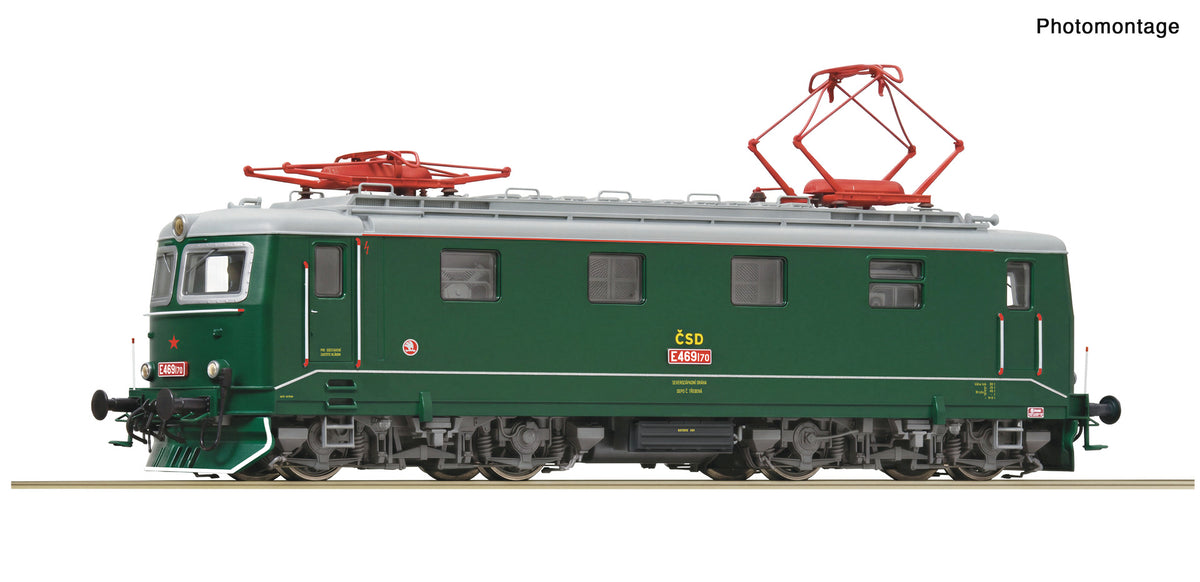
Electric locomotive E 469 170 of the Czechoslovak State Railways.
Based on the Skoda works type 43E
In dark green livery
Pantograph with innovative mounting
Intricately detailed bogies and spoked wheels
Fine metal wheels with low flanges
Some signage is also included as etched parts
In digital mode with switchable headlight/tail light, driver's cab and engine room illumination
In digital mode, with switchable underframe lighting in the ČSD style
In the early 1960s, the former Czechoslovak State Railways (CSD) required new, high-performance electric freight locomotives for the 3 kV DC system in the north and east of the country. Experience with the E 499.0 and E 499.1 classes, originally developed as universal locomotives, showed that they were better suited to passenger operations.
Consequently, while the E 499.157 locomotive was still in production, it was modified for freight service and designated E 469.001. It retained the same power output, but the manufacturer fitted it with a modified axle gearbox. Its service weight was increased to 88 tonnes by adding ballast. The production locomotives featured a modified body. Unlike the E 499.0, which had six circular windows on each side panel, the locomotives of the series E 499.1 and E 469.1 had four rectangular windows. With a continuous power output of 2,032 kW, they could reach a maximum speed of 90 km/h. In total, Skoda delivered 85 locomotives to the Czechoslovak State Railways.
The locomotives were primarily used to haul freight trains on main lines with gentle gradients. They were primarily used for coal block trains on routes from the North Bohemian lignite basin to the east, and were also in service in Slovakia from the 1960s to the 1990s. As derivatives of the E 499.1 series, these locomotives were fitted with electric train heating and could therefore also be used in passenger trains. The main reason for their limited use on passenger trains was their low top speed. Since the 1960s, most electrified lines had a maximum speed of 100 or 120 km/h. Consequently, the E 469.1 class locomotives were too slow for passenger trains. Nevertheless, they could often be seen in passenger service on selected routes.
In 1988, the class designation was changed from E 469.1 to 121. Some units were also transferred to the Slovakian railway company ZSSK. Since then, several locomotives have been modernised and acquired by private operators. Slovakia from the 1960s to the 1990s. As derivatives of the E 499.1 series, these locomotives were fitted with electric train heating and could therefore also be used in passenger trains. The main reason for their limited use on passenger trains was their low top speed. Since the 1960s, most electrified lines had a maximum speed of 100 or 120 km/h. Consequently, the E 469.1 class locomotives were too slow for the use in passenger trains. Nevertheless, they could often be seen in passenger service on selected routes.
In 1988, the class designation was changed from E 469.1 to 121. Some units were also transferred to the Slovakian railway company ZSSK. Since then, several locomotives have been modernised and acquired by private operators
- Coupling: NEM shaft 362 with close coupling mechanism
- Minimum radius: 358 mm
- Flywheel: yes
- Number of driven axles: 4
- Number of axles with traction tyres: 1
- Article number: 7510132
- EAN: 9005033073114
- Scale: H0
- Epoch: IV
- Railway Company: CSD
General data
- Head light: 3 headlight, dependent on the direction of travel/2 tail lights, dependent on the direction of travel
- LED head light: yes
- Additional light function: yes
- Interior lighting: Yes, LED, Digital switchable, Driver's cab lighting, Engine room lighting
- Control: DC Digital
- Interface: Electrical interface for traction units PluX22
- Digital decoder: PluX22
- Sound: yes
Electrical
- Length over buffer: 186 mm
Measurements
