
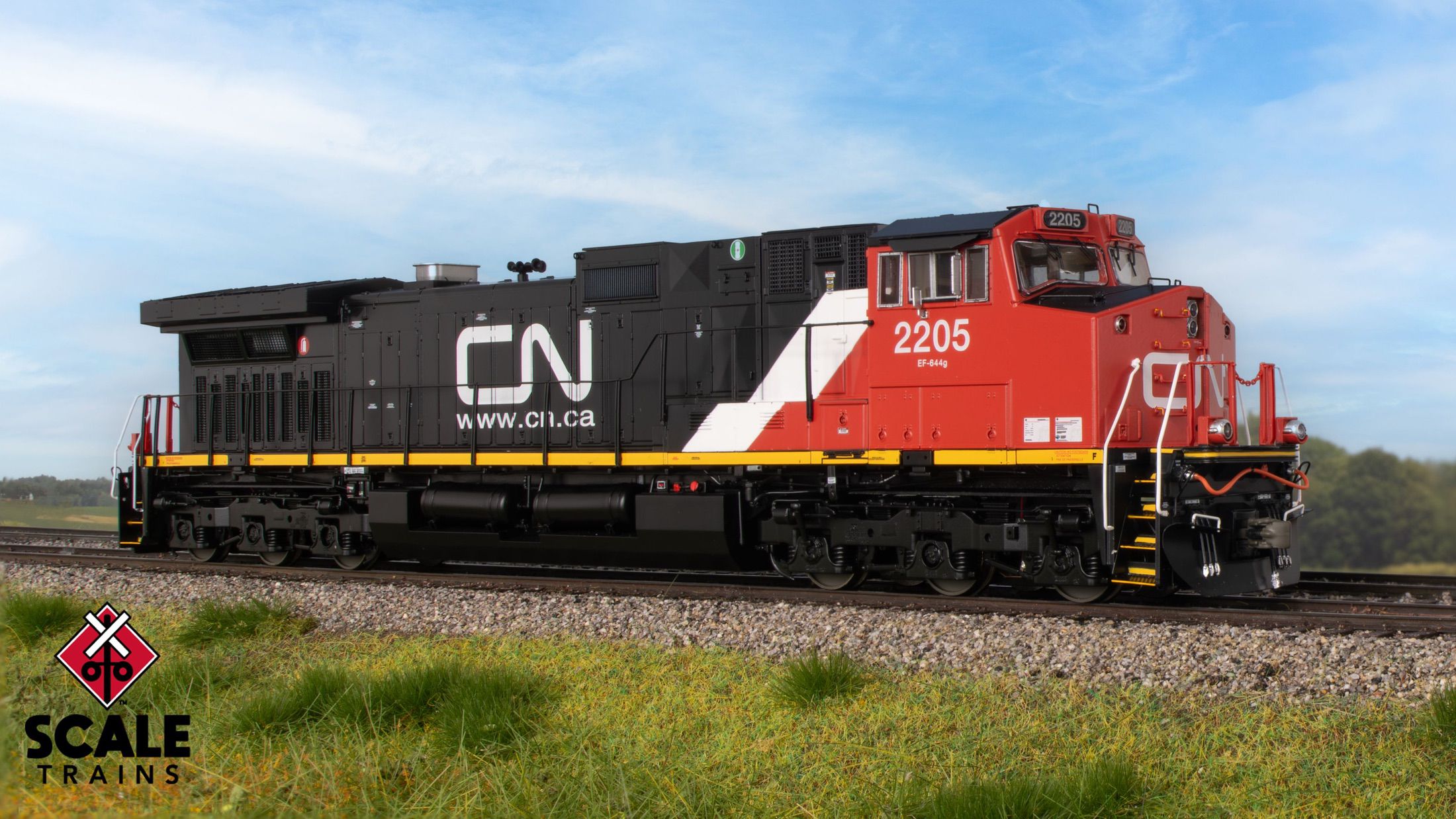
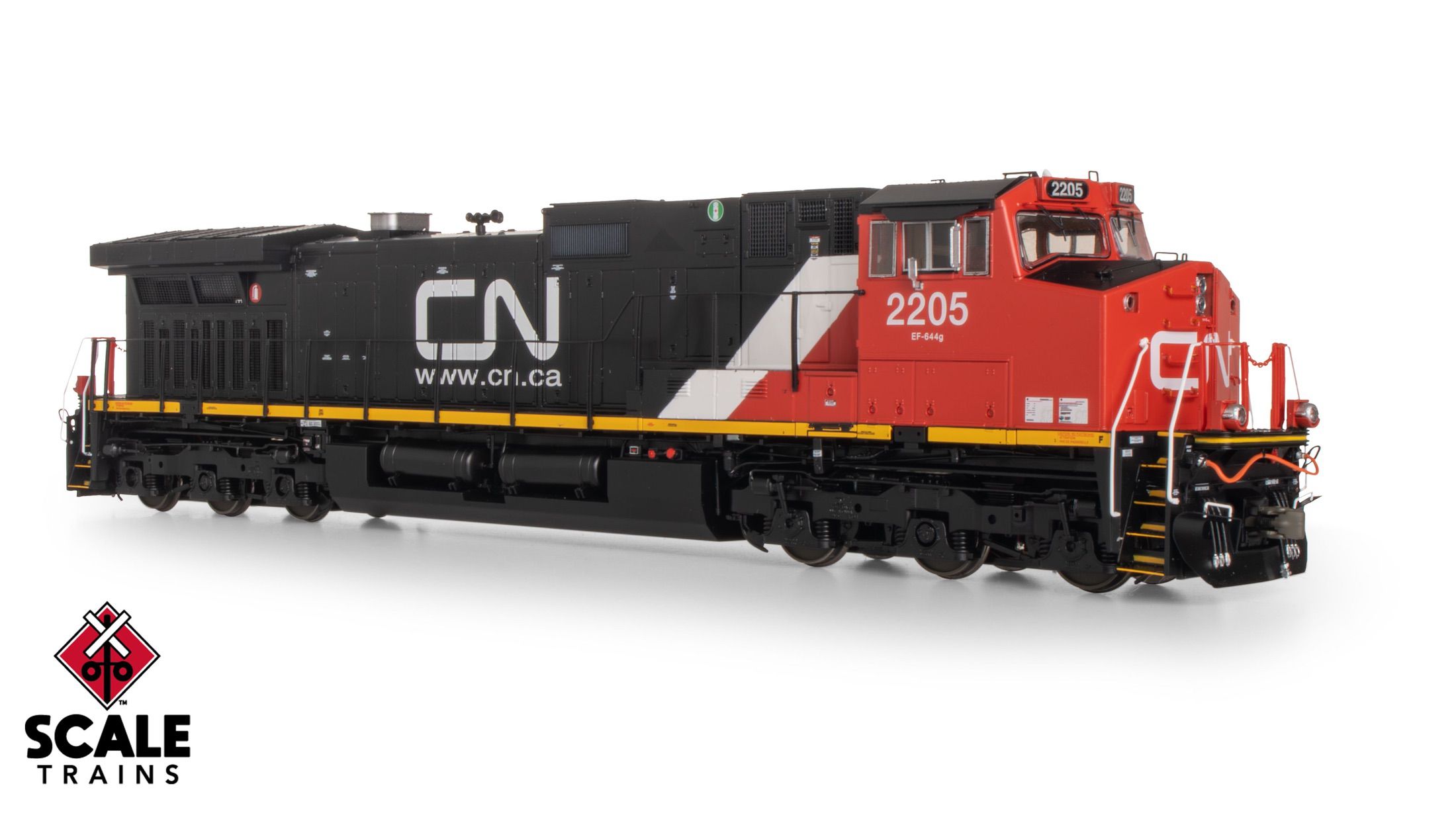


Description
The GE DASH 9 Series debuted in 1993 with numerous electronic upgrades, building on the DASH 8 platform. Available with 4,000 or 4,400hp, they were well-received by the railroads and their employees, quickly becoming one of the most common locomotive types in North America. The DASH 9s remained in production until the early 2000s when it was superseded by GE’s “Evolution Series” ES40/44-series models. Most are still in service today.
With railroad, road number, and era specific™ details, our Rivet Counter™ series DASH 9 is the definitive model of this popular GE locomotive. In our continuing effort to push the boundaries of realism in model railroading, the Rivet Counter DASH 9 features operating LED front, rear, and side walkway lights. Available as DC/DCC with a 21-pin connector or with ESU LokSound™ 5 DCC & sound pre-installed at the factory.
Road Number Specific ScaleTrains
- New road numbers
- Era: 2004 to Present
- Series 2200 to 2205, built 01-02/2004
- Canadian “teardrop” front windshields and red front and rear LED-illuminated marker lights
- Walkway with sectional see-through grating, and ribbed anticlimbers, front and rear
- Fully-assembled
- Multiple road numbers
- No truck ground lights (prototype not equipped)
- Operating LED front, rear, and side walkway lights*
- Operating LED front and rear deck-mounted ditch lights with visors **
- LED-illuminated high-mount cab number boards*
- Short snowplow with open doors and grab irons
- Semi-scale coupler buffer equipped with durable metal semi-scale Type E knuckle couplers
- 4-step stepwells with see-through steps
- GE “nub” pattern walkway tread
- Wide profile end handrails
- Front nose headlight
- Nose door without window
- Two-piece nose top grab irons
- Standard electrical cabinet access doors
- Battery cabinet access door with latch
- Cab interior with detailed back wall and front dash, high-back seats, conductor’s workstation, and engineer’s AAR-style control stand
- Tinted cab side windows
- Medium mirror mounted in front of sliding cab side windows on both sides; additional small mirror on right side
- Large Sinclair “ice skate” communication antenna and three small Sinclair “ice skate” antennas
- Electrical cabinet with drop grab irons on rear
- No walkway HVAC unit installed
- Continuous reinforcement rib under dynamic brake intake grilles, with emergency stretcher compartment adjacent
- Late dynamic brake exhaust
- Late angled engine cab profile with raised “dot” treadplate on centerline
- Lost-wax brass cast Nathan AirChime K3LA horn mounted on engine cab
- Late non-flanged exhaust stack housing
- “Bathtub” exhaust silencer
- 26 individually applied etched metal see-through radiator intake and exhaust grilles on the sides and top of the radiator compartment
- Right side late radiator door grilles in alternating heights
- Standard brake wheel
- Left rear hood door grille arrangement: tall, short, tall grilles
- High-mounted rear sand fill
- Late angled lifting “tabs” on ends of radiator wings
- Accurately profiled frame with separately-applied plumbing and traction motor cabling
- Late Hi-Ad trucks with cantilever struts on right front and left rear side frames, and flange lubricator sticks
- Rust-color painted wheelsets
- Rotating axle bearing caps
- Speed recorder on left side second axle
- Speed recorder on the second axle on both sides
- Dual Graham-White (Prime) 975-075 Air Filters
- Graham-White 975-100 “Twin Tower” Air Filter Dryer
- 5,000-gallon fuel tank with vertical weld seams
- Single fuel fills per side
- Digital fuel gauge
- Fuel tank-mounted steel bell
- Separate air tanks with lower mounting brackets and connector pipe
- Late handbrake chain brackets with dual pulleys
- Spare coupler knuckle holders on rear pilot face
- Factory-applied detail parts: wire grab irons, spare knuckles, trainline hoses with silver gladhands, 3-hose MU clusters with silver gladhands, uncoupling levers, windshield wipers, mirrors, sunshades, and more
- Motor with 5-pole, skew-wound armature
- Dual flywheels
- All-wheel drive and electrical pick-up
- Directional LED-illuminated headlights
- Printing and lettering legible under magnification
- Operates on Code 70, 83, and 100 rail
- Packaging safely stores the model
- Minimum Radius: 18”
- Recommended Radius: 22”
DCC & sound equipped locomotives also feature:
- ESU LokSound 5 DCC & Sound decoder with “Full Throttle” functions
- Two (2) cube-type speakers
- Turbocharged GE 7FDL16 prime mover sounds
- ESU designed “PowerPack” with two super capacitors***
- Operates on both DC and DCC layouts
DC/DCC & sound-ready locomotives also feature:
- Operates on DC layouts
- DCC-ready with 21-pin connector
* Lighting features operate when using an ESU decoder with appropriate programming while operating using DCC.
*** In DC operation, both front ditch lights illuminate; rear ditch lights (if equipped) do not illuminate
**** Compatible with appropriately programmed ESU decoders while operating using DCC
General Electric wrestled the title of top domestic locomotive builder from EMD during the late 1980s with their DASH 8 series. GE once again positioned itself to shake up the locomotive world again less than a decade later. Entering the 1990s, GE completely revamped its locomotive lineup by utilizing customer feedback, learning from experience gained from previous locomotive series, and improvements in technology.
A single C44-9W demonstrator, number 8601, debuted in 1993 (and later became C&NW 8601). While similar at first glance to predecessor models like the C40-8 and C40-8W, the Dash-9 series featured a few notable physical differences. Built on a slightly longer platform that allowed for a massive 5,000-gallon fuel tank, Dash-9s also featured thicker radiator “wings” at the rear of the carbody. This is usually the quickest way to differentiate them from previous models.
The GE DASH 9 series includes several models, including the C40-9, C44-9W, and C44-9WL. These models differ in power output, traction motor types, and other features, but share a common design and architecture. The DASH 9 series is characterized by its distinctive nose shape, angular lines, and robust construction.
One of the key features of the DASH 9 series is its high-power diesel engine, which produces up to 4,400 horsepower. This makes it one of the most powerful single-engine locomotives in the world. The engine is paired with a state-of-the-art traction control system, which optimizes power delivery and reduces wheel slip. This results in improved acceleration, braking, and overall performance.
The DASH 9 series also features advanced digital control systems, including a microprocessor-based control unit and a sophisticated monitoring system. This allows for real-time monitoring of the locomotive's performance, fault detection, and automatic control of various systems.
In terms of design, the DASH 9 series has a distinctive appearance, with a sloping nose, angular lines, and a robust construction. The locomotive's body is made of steel, with a durable paint finish and a range of optional liveries. The cab is designed for comfort and ergonomics, with a modern control stand, adjustable seats, and ample visibility.
The GE DASH 9 series has been widely adopted by freight railroads in North America and globally. Its high power, efficiency, and reliability make it an ideal choice for heavy-haul freight operations, particularly in mountainous terrain. Many railroads have also praised the DASH 9 series for its ease of maintenance, reduced downtime, and lower operating costs.
The DASH 9 series remained in production until the early 2000s when it was superseded by GE’s “Evolution Series” ES40/44-series models. Age has begun to catch up with the earliest C44-9W and related models so some railroads are storing and/or rebuilding these veteran units. NS’s oldest units, the spartan-cab C40-9s, have been rebuilt with the latest GE safety cab for increased crew comfort and safety plus AC traction for better performance.
In conclusion, the GE DASH 9 series has earned a reputation as one of the most reliable and efficient locomotives in the world. Built over a long timeframe, and proving to be a solid, upgradeable platform, the C44-9W family of locomotives including rebuilds is sure to remain a fixture on today’s railroads for the foreseeable future.


