
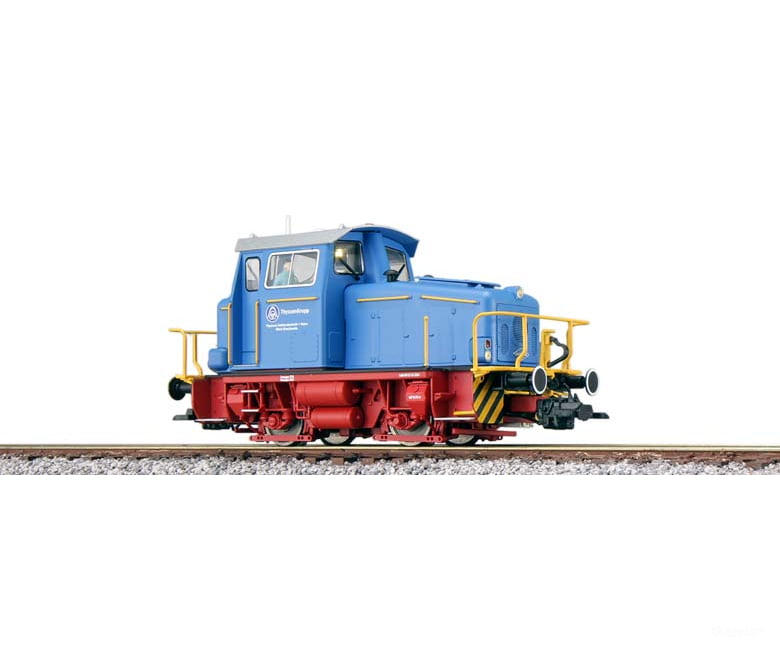

Description
- Metal body and chassis
- Perforated fan grilles on the front of the long hood
- Finely detailed, multi-colored driver's cab
- Numerous separately applied details on the chassis
- Separately applied and partially perforated steps
- Freestanding handrails
- Sprung buffers
- Installed driver figure
- Height-adjustable digital shunting coupler for all loop couplers
- Coreless motor with flywheel
- Drive on both axles, one traction tire
- LokSound 5 decoder for DCC, Motorola®, M4 and Selectrix® operation
- Automatic registration with control units with RailComPlus® functionality
- PowerPack storage capacitor for uninterrupted power supply
- Speaker with large sound chamber for maximum sound enjoyment
- Universal electronics with plug-in pickup shoe and slide switch for switching between two-rail and center-rail operation
- Smoke generator synchronized with LokSound
- Digitized original sounds of a locomotive with an air-cooled 12-cylinder Deutz A12 L 714 engine or a water-cooled locomotive with a BA6M-716 Deutz diesel engine
- Directional lighting, switchable headlight on the train side, shunting, cab and control panel lighting, 31431 and 31439 with flashing light
- Brake sparks during hard braking
- Chassis lighting
- Length over buffers = 92.3 mm
Starting in 1962, German manufacturer Deutz offered the two-axle diesel-hydraulic KG 230 B in the Köf III power class. KG stands for small locomotive with cardan shaft drive, 230 for the power in hp, and B for the wheel arrangement. The in-house air-cooled twelve-cylinder A12L714 engine produced 230 hp at 2000 rpm. The seven KG 230s built for explosion-sensitive factories were equipped with a water-cooled six-cylinder diesel engine. The transmissions of most locomotives were set to a top speed of between 20 and 30 km/h for the sake of tractive power. Depending on the track layout, customers had additional metal installed in the frame area, allowing the locomotives to be ordered with a weight of 26 to 36 tons. The two locomotives of Bayernhafen AG, the BEHALA locomotives, even had multi-control systems. Despite their advanced age, many of the two-axle locomotives still in use today still have their original engines. Since most companies owned only a few traction units, they were kept in good technical condition, as they could not be spared. The list of owners reads like a who's who of major European industries: BP, VTG, Thyssen-Krupp, Mannesmann, Feldmühle AG, Rheinpreußen, to name just a few. The well-known private railway HVLE even painted its KG 275 in its well-known company colors. Port logistics, for example, at Luxport in Luxembourg town Wasserbillig, also relied on the stability and tractive power of the air-cooled two-axle locomotives. The high quality of the construction is demonstrated by the fact that the locomotives are not scrapped but resold when there is no longer any demand.
